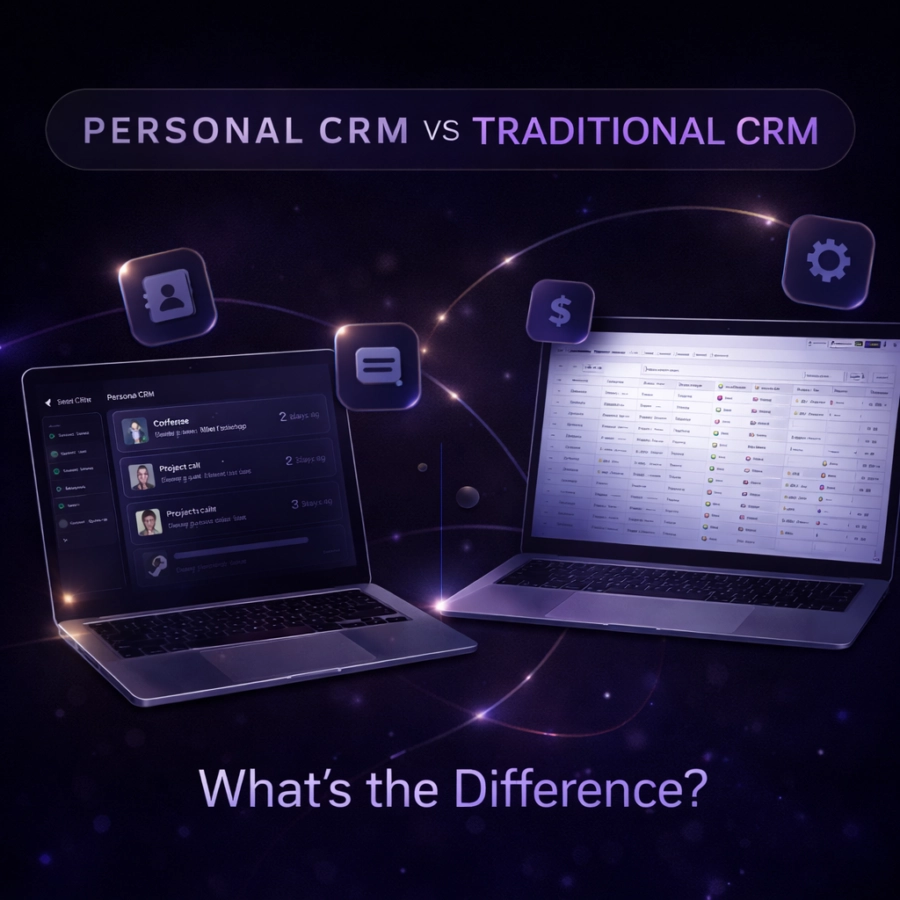
When people talk about CRM, they often assume everyone means the same thing. The truth is far more nuanced. The CRM software that powers a sales team at a Fortune 500 company looks almost nothing like the tools designed for freelancers, entrepreneurs, or anyone managing their personal and professional relationships. Understanding these differences can save you from investing in expensive software you do not need, or worse, missing out on tools that could genuinely transform how you connect with people.
What is a Traditional CRM?
Table of Contents
A traditional CRM, like Salesforce, HubSpot, or Zoho, was built with one primary goal in mind: helping sales teams close deals faster. These platforms excel at tracking leads through a sales pipeline, managing customer interactions at scale, and generating forecasts for revenue. They are designed to answer questions like: How many deals are in our pipeline? Which sales rep is closing the most? What is our average deal size? What stage is this prospect in?
Enterprise CRMs typically include features like pipeline management, deal tracking, workflow automation, integration with email and calendars, sales forecasting, and detailed analytics. They work best when you have multiple team members collaborating on the same customers, or when you are running a formal sales process. The software is powerful precisely because it is built to handle complex organizational needs.
But that power comes with a cost. Traditional CRMs usually require per-seat licensing, significant setup time, training for your team, and ongoing maintenance. You are paying for functionality designed to support dozens, hundreds, or thousands of users working together. Even the most basic plans often cost $50 to $100+ per month per user. And the learning curve can be steep, with extensive customization needed to fit your specific business process.
What is a Personal CRM?
A personal CRM takes a completely different approach. Instead of focusing on deal pipeline and team collaboration, personal CRMs are designed to help individuals nurture and maintain their relationships. Whether you are a solopreneur, consultant, freelancer, or someone who simply wants to be more intentional about staying connected to your network, a personal CRM keeps track of the people who matter to you.
Rather than asking “What deals are in my pipeline?” personal CRMs help you answer: When did I last talk to this person? What do I know about them and their family? What did we discuss last time? When should I follow up? Who should I introduce to each other? Personal CRMs shift the focus from transactions to relationships, from process to connection.
These tools typically include features like contact management, relationship history, tags and custom organization, follow-up reminders, interaction logging, and simple analytics about your network. They are designed to be intuitive enough to set up in minutes, not hours or days. And they are almost always affordable, with many offering free plans or pricing under $20 per month.

Key Differences Between Personal and Traditional CRMs
Purpose and Focus
The fundamental difference is about what you are trying to accomplish. Traditional CRMs are transaction-focused. They are built to move prospects through a sales funnel and close deals. Personal CRMs are relationship-focused. They are built to help you remember details, stay in touch, and nurture genuine connections over time. This is not just a matter of features, it is a matter of philosophy. One views customers as revenue opportunities. The other views people as relationships worth maintaining.
Complexity and Setup
Traditional CRMs come with a steep learning curve. Customization often requires technical expertise. You need to define your sales process, set up custom fields, configure workflows, and train your team. Expect to spend days or weeks getting it right. Personal CRMs are designed for simplicity. You can set up a contact, add notes, and create a reminder in seconds. The interface should feel natural, not like learning new software. Setup takes minutes, not months.
Pricing Structure
Traditional CRMs charge per user per month. If you have five people on your sales team, you are paying for five licenses. A typical enterprise CRM might run $500 to $3,000+ per month for a small team. Personal CRMs flip this model. They are either free, or they charge a modest monthly or annual fee that covers unlimited features for one person. You are not paying for seats, you are paying for access.
Privacy and Data Ownership
With traditional CRMs, your customer data lives on the company’s servers. It is their platform, their database, their terms of service. Your data is part of their product. Personal CRMs increasingly prioritize privacy and data ownership. Many use local data processing and encrypted backups, ensuring that your personal information stays private and under your control. This matters especially when you are storing sensitive information about your network.
Features and Capabilities
Traditional CRMs offer deal tracking, pipeline management, sales forecasting, and workflow automation designed around closing business. Personal CRMs offer relationship mapping, interaction history, tags for organizing people, follow-up reminders, and often things like business card scanning or custom event tracking. Neither approach is better in an absolute sense; they are just designed for different purposes.
User Type
Traditional CRMs are team tools. They assume multiple people will be accessing and updating the same records. Personal CRMs are individual tools. They are designed for one person to manage their own relationships. Some can support collaboration, but that is secondary to the core experience of one person maintaining their network.
When a Traditional CRM Makes Sense
If you have a formal sales process, a team of salespeople, and you need to forecast pipeline or track complex deals with multiple stakeholders, a traditional CRM is the right tool. If you need to integrate with your company’s existing systems, manage customer service workflows, or report on team performance, you need that enterprise infrastructure. If you are managing hundreds or thousands of customer relationships with formal processes around them, the investment in a traditional CRM pays off.
Traditional CRMs also make sense if you need advanced analytics, complex automation, or if your business depends on standardizing how your team handles customer interactions. They are powerful for their intended purpose. The key is asking whether you actually need that power.
When a Personal CRM is the Better Choice
If you are a freelancer, consultant, coach, or solo business owner, a personal CRM is almost certainly the better choice. You do not have the overhead of managing team pipelines, and you likely want something simple that you can actually use every day. If you are focused on relationship-building rather than transaction-closing, a personal CRM aligns perfectly with your goals.
Personal CRMs also make sense for people who want to be more intentional about their networking, entrepreneurs building their personal brand, professionals who want to remember details about the people they meet, and anyone who values their privacy and wants to own their own data. A personal CRM helps you be genuinely good at staying in touch, not just efficient at selling.
Can You Use Both?
Yes, absolutely. Many solopreneurs and professionals use a personal CRM alongside a lighter business tool. A personal CRM helps you manage relationships broadly, while a lighter tool might help you track specific projects or client work. The two serve different purposes and can work together rather than against each other. The key is avoiding over-complexity. You want tools that make your life easier, not harder.
How Dextr Brings Personal CRM Power to Everyone
If you have decided a personal CRM is what you need, but you are overwhelmed by the options or unsure what to look for, consider Dextr. Dextr is a personal CRM app for iOS and iPad that solves the problems discussed throughout this article.
Dextr is built specifically for individuals who want CRM power without enterprise complexity. It starts simple: sync unlimited contacts, add notes about your interactions, and set follow-up reminders. But it includes sophisticated features like custom relationship types to categorize how people fit into your network, tags for organizing your contacts in multiple ways, and bulk tagging to quickly organize groups of people. The AI Organizer Assistant helps you get organized faster, while interaction logging ensures you never forget an important conversation.
For people who attend networking events or conferences, Dextr includes business card scanning so you can capture new contacts instantly. Want to stay in touch with specific groups? Send text blasts to all contacts with a particular tag. Need to remember when to check in? Set custom event reminders. Dextr handles all of this while keeping your data private through local processing and iCloud encrypted backup. Your relationship data belongs to you, not to a company harvesting your network.
Pricing is refreshingly simple. Dextr offers a free plan that stays free forever, monthly plans starting at $1.99, annual plans at $1.25 per month (billed $14.99 yearly), or a one-time lifetime purchase for $59. Compare that to traditional CRM licensing, and Dextr is practically giving away relationship management power.
If you want to learn more about Dextr and see if it is the right fit for you, visit Dextr on the App Store. You can check out the pricing page to see all options, browse the learn section for tutorials, or check the FAQ for common questions. Dextr is available on the App Store, and you can download it today.
Final Thoughts
The CRM landscape is broader than many people realize. Traditional CRMs and personal CRMs serve fundamentally different purposes, and choosing the right tool starts with understanding what you actually need. If you are building relationships instead of closing deals, if you are working solo instead of managing a team, and if you value simplicity and privacy, a personal CRM like Dextr gives you everything you need to stay connected to the people who matter. Start with a tool built for your actual use case, not one designed for a different kind of business entirely.